
If you struggle with anxiety, you’re probably very familiar with how it impacts your mind. There’s a good chance you have an active brain that is skilled at coming up with detailed (and often terrifying!) scenarios. This is the blessing and the curse of the anxious brain. We can be wildly anxious or wildly imaginative. In fact, there’s been research to confirm that people with anxiety tend to be more intelligent with a greater connection to creativity as well. So how do we channel this active mind and anxiety into our creativity to improve overall well-being? Here are some ideas:
Art
You don’t need to be a skilled, trained artist to use art to reduce your anxiety. Making art for anxiety reduction is much more about the process than the product. By approaching art-making from a mindful stance you can become more present and aware of your emotions in the moment.

Art-making for anxiety
Focus on the process, not the product
Examples of art exercises for reducing anxiety:
Drawing the breath: all you need for this activity is a pen or marker and a piece of paper. Begin slowly drawing a line any direction and practice synching the movement of your breath with the movement of your pen. Take in the sounds of your breath and the movement of your pen on the page. Don’t worry about what you’re creating and allow yourself to be surprised rather than trying to control the outcome. You can also try this exercise with your eyes closed or even while mirroring someone else to make it a co-regulating exercise. You can see a video here with more explanation of the exercise.
Collage: grab some magazines and cut out some images that speak to you. You could start with the intention to cut out images that bring a sense of calm or grounding. Or you can simply allow yourself to collect images that you feel drawn to without overthinking it. Arrange the images on the page in a way that feels right to you. After you’ve completed your art, you could take a few minutes to free-write what you see in the piece and what the process was like for you. Remember, there’s no right or wrong! So if you find yourself passing judgment on yourself or what you’ve created, see if you can return to a place of self-compassion and curiosity.
Journaling
You may have been encouraged to write or journal for your anxiety in the past. Many of my clients find it difficult to journal for mental health because they might feel more anxious as they write, focusing on all the worries. It’s important to have a structure for journaling for anxiety that helps you use it in a productive way, rather than spiraling deeper into anxious thoughts.
Journaling exercises for anxiety:
The Voice of Self-Compassion:
For the exercise you’re doing to write in two voices: the voice of an emotion and the voice of your self-compassion. Start by taking a moment to breathe and tune into yourself. Notice how you are feeling in your body. Name and describe the sensations you’re feeling. After sitting with this for a few minutes, see if you can identify the emotion beneath the sensation. Is it anger? Is it sadness? Fear?
Once you’ve identified your emotion, make that the “voice” you first write from. Let that emotion speak and write what it wants to say.
Next you will respond to your emotion with a voice of self-compassion. All the self-compassion voice does is show love, validation, and care to that voice of emotion. You’re not going to problem-solve or argue with the statement. Think of it as how you would respond to the person you love most in the world if they were expressing this emotion. It might look something like this:
Voice of fear: “I feel overwhelmed and terrified about what’s happening in my relationship. I’m afraid of being hurt and deep down, I fear that I’m unloveable”
Voice of self-compassion: “I hear you. It is so frightening to be vulnerable. I see how deeply you care and how much love you have to give.”
Connect with Values:
Use journaling as a way to reconnect with parts of yourself you’ve lost touch with because of your anxiety. Here are some questions to guide you:
If my anxiety magically disappeared tomorrow, what’s the first thing I would do? How might I act differently with people in my life? What risks would I take knowing that I’ll be okay?
Remember a time when I felt anxiety about something and did it anyway. What was the experience like before or leading up to the event? How did I feel? What helped you get through the experience? What wisdom did I gain or strengths did I notice about yourself afterwards?
If I had an entire week to spend doing anything I wanted, what would I do? Get very specific describing where you would go, what you would do and who you would spend that time with? How might you integrate some of these things into your life now?
Movement and nature:
We know that movement and exercise can be good for anxiety. Adding in creative expression can help you release anxiety from the body and help to express underlying emotions. Add in some time outdoors with the natural world, which has shown to have many benefits for your mental health, and you triple the anxiety-relief power! Here are some ideas of how to use creativity, movement, and connecting with your environment to reduce anxiety:
Mindful Photo Walk:
Most of us have our phones with us everywhere we go. Why not use them for good by using them as a creative tool to reduce anxiety?
Go on your walk with the goal of finding images or moments of beauty, peace, or just anything that brings you a sense of awe.
Take photos as you walk and also notice how you feel in your body as you move. Afterwards, you can collect the images to create a digital collage or create a reel to share on Instagram. Or place the images in a special folder to return to when you’re feeling anxious to help ground you.
If the weather is too cold, you can also take this challenge around your home or even just your room. Find items or images indoors that bring you a sense of peace like the light coming through your window or the close-up texture of your favorite blanket.
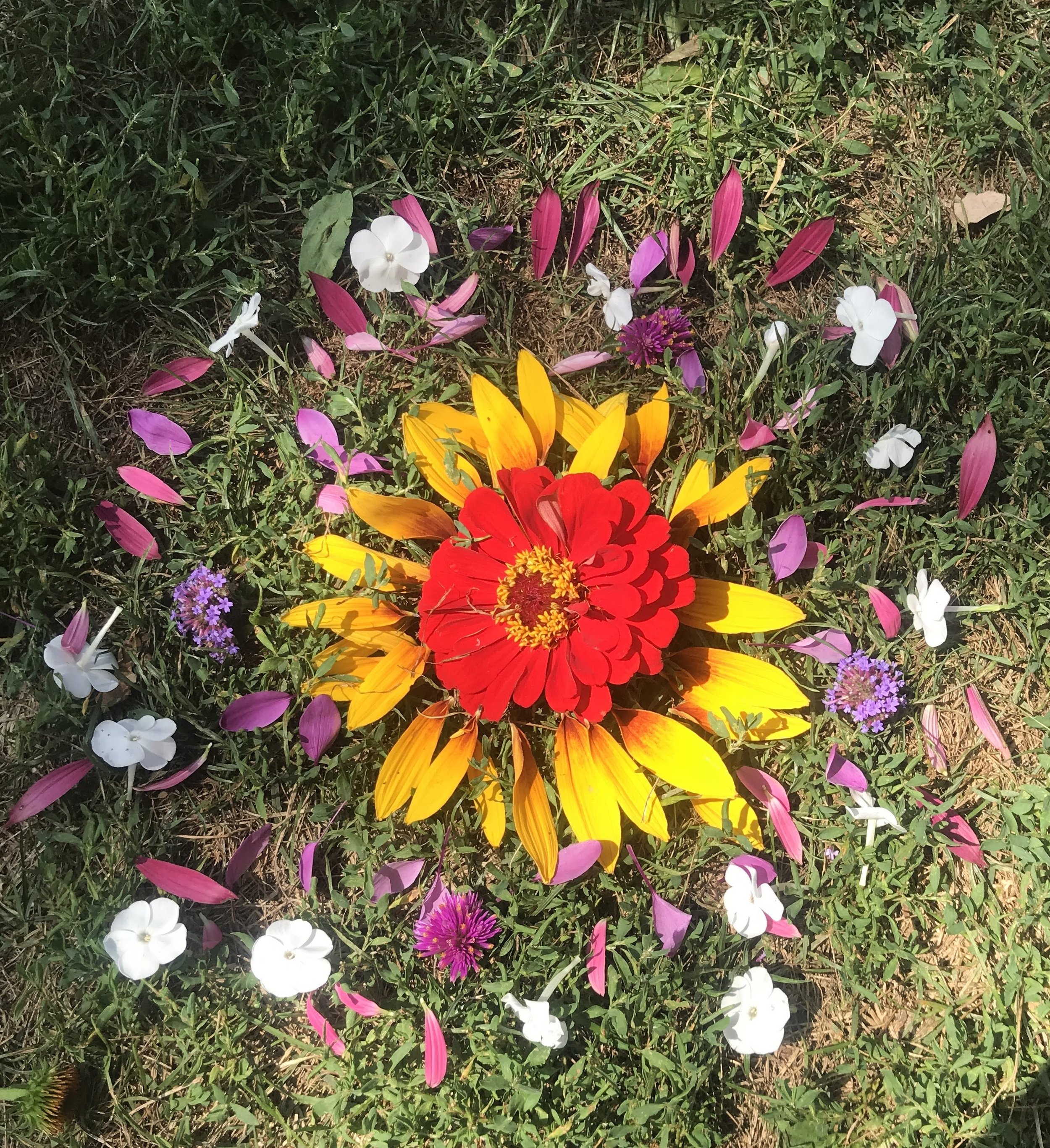
Creativity inspired by nature to heal anxiety
Using moments in nature as inspiration for art-making and mindfulness tools
Nature collage or mandala:
Find a place outdoors that’s somewhat clear and quiet, whether it’s a hiking trail or your backyard.
Take a few moments to breathe and focus on being present in your body, then begin to take in the environment around you.
Begin to collect items you find beautiful or that bring you a sense of peace. It can be leaves, rocks, flower petals or even sticks. Focus on textures and colors you find interesting or beautiful.
Bring the items back to your clearing and arrange them in any way you like to create a collage or mandala with a circular, patterned design. Follow your intuition about how you want to arrange the items.
You can take photos of your creation to save for later. Or take a few moments to take a “mental image” of what you created and notice if you feel any change in your body or anxiety afterwards.
Would you like more support and creative ways to heal your anxiety? If you live in Massachusetts, reach out to Rachel to schedule a free initial consultation for therapy. Rachel is a certified EMDR therapist who integrates expressive arts therapy modalities into EMDR intensives to help clients heal anxiety, burnout, and trauma. Interested in learning more about EMDR intensives? Check out the link below.

Rachel Duvall, LICSW certified EMDR therapist and anxiety specialist
If you’re looking for deeper support beyond self-help tools and want to work with a therapist who blends evidence-based methods like EMDR (Eye Movement Desensitization and Reprocessing) with creative approaches to anxiety healing, consider reaching out to Rachel. She offers a free initial consultation and works in Great Barrington, Massachusetts, online in Boston, and throughout Florida, to help you move from coping to healing in a holistic, expressive way.
Rachel Duvall is a licensed therapist with over 14 years of experience supporting clients in New York City and now Great Barrington, MA. She specializes in EMDR therapy and EMDR therapy intensives for women, parents, and LGTBTQIA+ struggling with anxiety disorders, trauma, perfectionism, and low self-esteem. Rachel uses evidence-based, somatic, holistic therapy approaches like EMDR and Sensorimotor Therapy as well as expressive arts therapy approaches to help clients feel calmer and more confident in themselves and their relationships. At Rachel Duvall Psychotherapy, she is committed to providing compassionate, expert care both in-person and online for clients across Massachusetts and Florida.
Rachel provides in-person therapy in Great Barrington, MA, in addition to providing trauma therapy online for women and LGBTQIA+ located in the areas of Springfield, MA | Boston, MA | Newton, MA | Hingham, MA
Trauma therapy online for residents of Florida including Miami, FL | Tampa, FL | Sarasota, FL | Orlando, FL
